

From Column to Podium
Speaking across cultures in Japan


Between the years 1979–1999 I was a columnist for the Japan Times. As Japan’s oldest and largest English-language newspaper, I think I was fortunate to have it as a forum. At a time before the internet, I often received typed and handwritten letters of appreciation from readers, and I answered (and kept) each one.
Since I live in the middle of nowhere, it was only through chance encounters that I had the pleasure of meeting readers of my “Crossing Cultures” column. Perhaps in a café, or an airport, upon recognizing me from the photograph that accompanied my column, the person would stop, peer into my face and tentatively say, “Don’t I know you?” Or with certainty, “I know you!”
I would later have the opportunity to meet readers when I was invited to give talks to various groups and organizations in Japan. That’s how I came to enjoy public speaking.
However, in the beginning I’d have an attack of what I called pre-talk Subliminal Anxiety Syndrome. People who travel a lot know about SAS. It manifests itself in dreams that you’ve left your luggage (or children!) on station platforms, or you’d arrived at your destination having forgotten everything it was essential for you to bring.
When SAS hit me in my dreams, it would be that I’d shown up an hour late for an hourlong talk. Or, I’d be standing at a podium in an old dress I wear around the house, and had forgotten to wear shoes.
In reality, on one occasion I became so nervous just as I was beginning to speak, I thought I would try to calm my nerves, and wet my completely parched throat, by taking a sip from the glass of water that had been so thoughtfully provided. That maneuver didn't work. When I picked up the glass, my hand shook so badly I couldn’t get it to my mouth. I was just barely able to replace the glass on the lectern without spilling the water.
I suppose time and experience pay off because the jitters are behind me. What anxiety I still get when I lecture helps me focus, and it’s tinged with the excitement I experience and gratitude I feel for being able to talk to people who want to listen to what I have to say. And it helped that I learned to tell myself these three things: 1) relax 2) they are people 3) they invited you here.
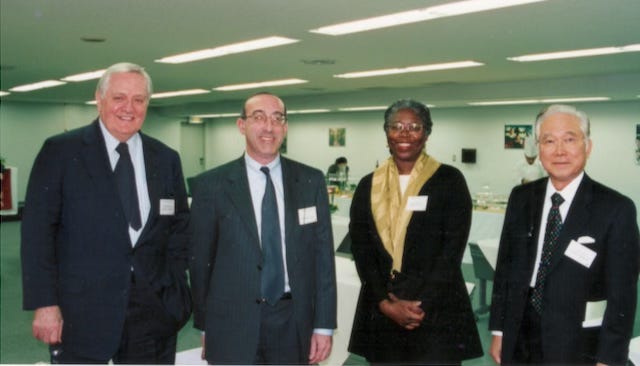
When I first began lecturing, I noted that I’d been in Tokyo more times in two years than I had been in the previous twenty. It was a revelation to find there were so many organizations for foreigners, and that their networks were far-reaching. In Tokyo, there appeared to be a steady stream of luncheons, dinners, parties, balls, seminars, classes, workshops, book groups. I admitted to feeling envious of the foreign women living there who had a wide circle of friends and a thoroughly satisfying social life.
Sometimes I was asked to speak to groups that were all Japanese. And at one such event, I had the unnerving experience of delivering a talk to a group of over 65-year-old men who were meeting on the general theme of 50 years since the end of World War II, and, more specifically, on Japan’s wartime role in Asia. Happily, I found that just like the time I addressed a group of high-ranking Western military officials, common ground was easily established — as they were keen to learn about my life and experience of living in rural Japan.


Beginning in 1983 and for the next fifteen years, I wrote for a regional edition of the national newspaper Chunichi Shimbun. The readers, exclusively Japanese, were invited to translate my column, titled “Another Look”. Once a year, the editor, Mr. Kazuo Narita, invited readers to meet me at a talk he organized.
At one talk, Narita-san warned me that a Mr. Tanaka, apparently a bit of an eccentric, might show up. He said that he hoped the man wouldn't disturb me. When I asked how he might do that, he answered: ”Well, at this other meeting we had, he stood up and put drops in his eyes in the middle of the talk.”
Hmm. Interesting. But I said, “Look, as long as the man doesn’t attack me, I don’t care what he does. And if he doesn't have a weapon and isn’t known to be disgruntled, he can do anything as long as he doesn’t interrupt.”
Generally, after a talk, questions are taken. Often the questions are not questions but statements. Sometimes they’re songs. Like the time — it’s many years ago now — after I’d spoken to a group of Japanese women and the moderator asked if there were any questions, a woman stood up and said:
“I was born in 1903. I learned English a long time ago. I would like to sing you a song, if I may.”
I said that, of course, we would all be delighted, and indeed we encouraged her with a round of applause. In a sweet soprano she sang a rendition of the Stephen Foster song,“My Old Kentucky Home”, which includes the line of longing for “the old plantation”. When she finished I thanked her and we all clapped warmly.
Another time when speaking to a local group of all Japanese, I said something critical (not harsh or offensive) about Japan. When I took questions, one woman, clearly displeased, asked me:
“Why do you stay in Japan if you don’t like it?”
I answered that I never said I didn't like Japan. But as no country is a paradise, I would probably be critical of some aspect of any country I live in.
And I told her: “You live in Japan because you were born here, and all your family members are here. I live here purely as a matter of choice. I probably like Japan better than you.”
She smiled sheepishly, and murmured, “You’re probably right.”
And I told her: “You live in Japan because you were born here, and all your family members are here. I live here purely as a matter of choice. I probably like Japan better than you.”She smiled sheepishly, and murmured, “You’re probably right.”
Hear, hear! I shall remember this one.
I lived in Japan between 1989-1991 and I enjoyed reading your columns then. I still have some I clipped from the paper! Glad that you are still well and writing.